
Video by what changes on screen
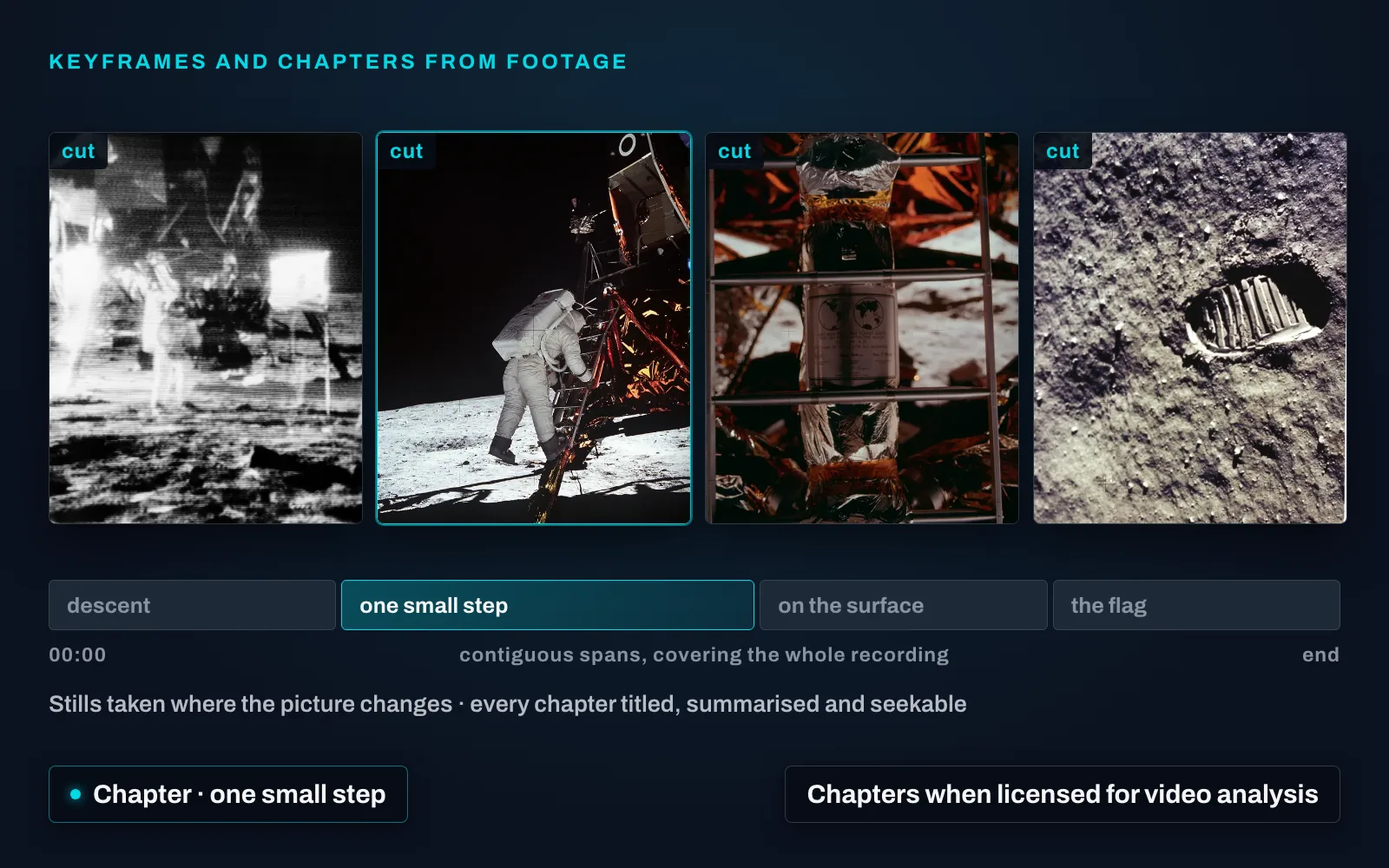
A recording is indexed by what changes in it. Stills are now taken where the picture actually changes rather than at a fixed interval, and only the frames worth keeping are stored — nothing blank, nothing blurred, nothing that is a near-repeat of a still already held. Those stills are what a picture search matches a video on, so a recording can be found by a frame in the middle of it. Existing videos keep the stills they have until they are re-rendered.
Chapters that cover the whole recording. Where the installation is licensed for video and language analysis, a completed analysis also produces chapters: contiguous titled spans that together cover the recording end to end, each with a summary, each linked to the subtitles and the recognised faces inside it. They are stored as segments, which means they are searchable, seekable from the list beside the player, and usable as the starting point of a More like this. A span with no speech in it is still listed so the recording stays navigable; it simply carries no summary. And if chapters cannot be produced at all, the analysis still succeeds — a recording is not left unindexed because one step did not land.
In similarity, too. Video now contributes a picture signal through its keyframes, alongside its metadata and its text. A single long recording can no longer crowd a result set with its own frames.
What enrichment adds — and how it stays marked as added — is on the platform page.