
Dates in two calendars
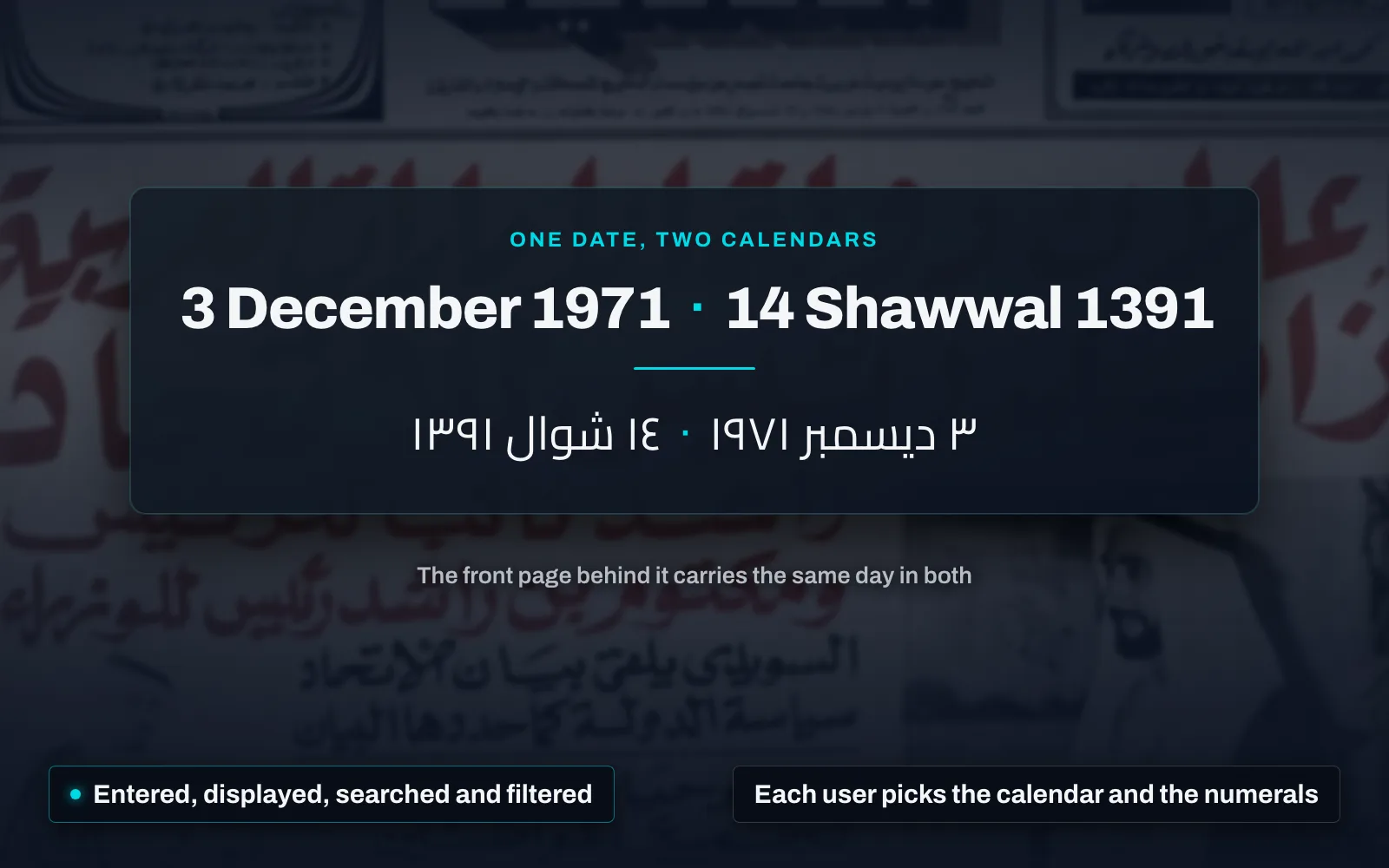
An archive in the Gulf keeps two calendars, and now so does the catalogue. Dates can be entered, stored, displayed, searched and filtered in both Hijri and Gregorian, on the same field and in the same record. A cataloguer types the date the document itself carries; the other reading is kept beside it. Neither is the copy, and neither has to be typed twice.
The filters follow the calendar. Timeline facets are calendar-aware, so narrowing to a year narrows to that calendar’s year and the counts describe it. Each field can be configured for the calendar it belongs to, and Arabic-Indic and Persian numerals are handled wherever numerals appear — in what is entered, in what is shown and in what is sorted.
Dates read off the page are read in both languages. When a date is taken from a document rather than typed, Arabic and English month names are both recognised, so a masthead yields a date rather than a line of text that happens to contain one.
And the choice is per person, not per installation. Each user picks the calendar and the numeral system they read in, and the interface answers in it. A date someone has corrected by hand keeps the fact that it was corrected and can be reset to the derived value at any time; titles sort with Arabic-aware ordering.
The rest of how material is described and arranged is on the platform page.