
Publishing outward: harvesting and structured data
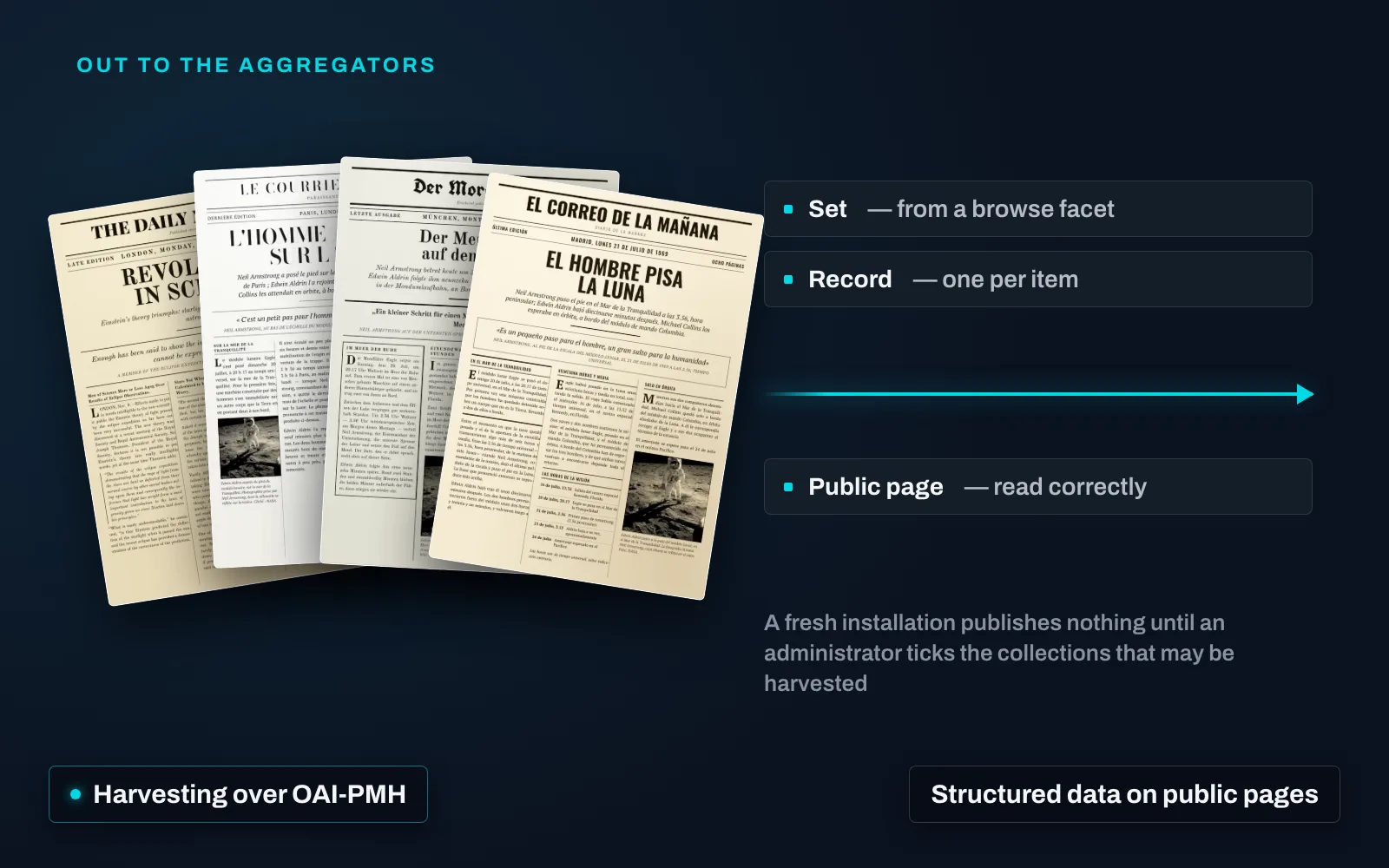
The catalogue leaves the building on the standards the sector already speaks. Records are exposed over OAI-PMH, in Dublin Core and in the Europeana Data Model, one record per item and dates in the standard form. Harvesters walk the feed page by page; the same feed opens in a browser as a readable page, so anyone can check what is actually being published without writing a client to do it.
The sets come from the way you already browse. An administrator chooses which fields become sets, and each distinct value of a chosen field is one. The sets a harvester sees are the facets your readers see, rather than a second structure maintained by hand and drifting from the first.
One mapping, two audiences. Each content type is mapped once — for search engines, for Dublin Core, for the Europeana model — and that mapping produces both the harvest response and the structured data embedded in the public page, so a partner catalogue and a search engine read the record the same way. The editors take a target type, an optional excerpt with a maximum length, fixed values such as a rights-statement address, and per-property visibility, so a field that should not leave the archive does not leave it.
And nothing is exposed until you choose it. A fresh installation publishes nothing at all: no collection is ticked, and no collection is harvested until someone ticks it.
What else goes out, and in what form, is on the platform page.